RunPack
How it works
Compared with you. Nobody else.
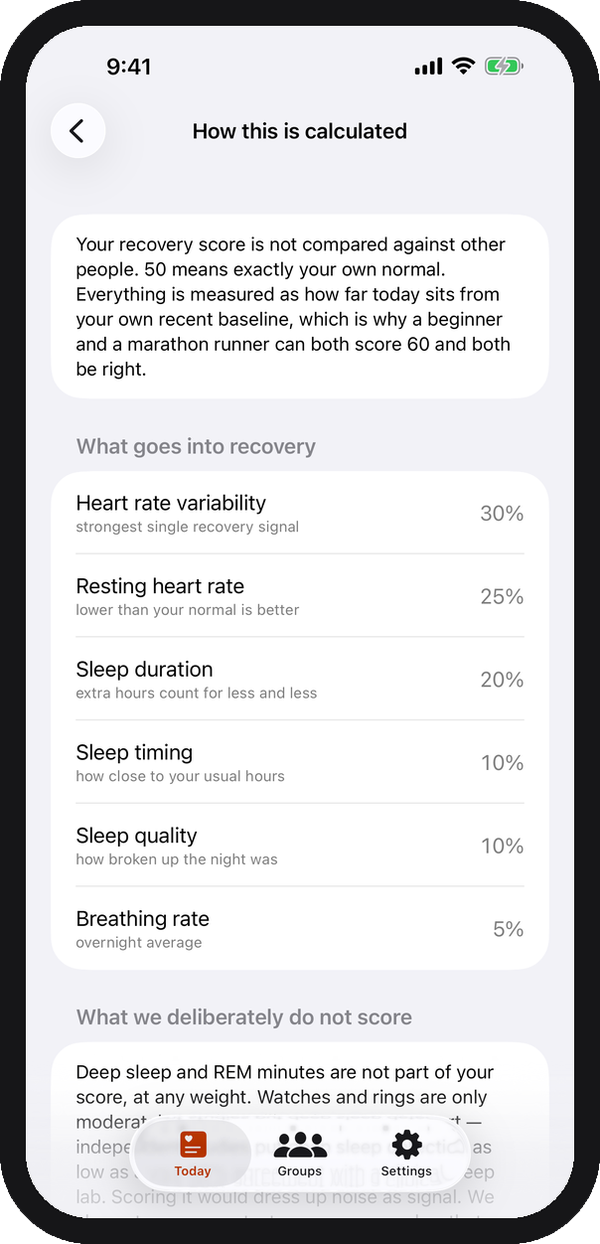
Your recovery score isn’t measured against other people. 50 means exactly your own normal. Everything is how far today sits from your recent baseline — which is why a beginner and a marathon runner can both score 60 and both be right.
What goes into the score
Each signal is compared with your own recent values. If one isn’t measured, the others are re-weighted so a missing signal never quietly drags you toward the middle.
| Signal | Why it matters | Weight |
|---|---|---|
| Heart rate variability | The strongest single recovery signal | 30% |
| Resting heart rate | Lower than your normal is better | 25% |
| Sleep duration | Extra hours count for less and less | 20% |
| Sleep timing | How close to your usual hours | 10% |
| Sleep quality | How broken up the night was | 10% |
| Breathing rate | Overnight average | 5% |
Bands, and what to do
Every score falls in a band. With your training ramp, the band becomes plain guidance: good day to push, a normal day, keep it easy, or rest or move gently. And always: if you feel different from the number, trust how you feel.
| Band | Score | Meaning |
|---|---|---|
| Prime | 95–100 | Well above your normal |
| High | 75–94 | Above your normal |
| Moderate | 50–74 | Around your normal |
| Low | 25–49 | Below your normal |
| Poor | 0–24 | Well below your normal |
Honest by default
A band when data is thin
If too little was measured, you get a band or a day counter instead of a number. A precise-looking score built from one weak signal is worse than admitting the reading is thin.
About three weeks to learn you
RunPack reads up to 90 days of history when you first open it, so most people get a score straight away. New watch? Give it a few weeks of nights.
No sleep-stage scoring
Deep and REM sleep aren’t part of your score. Wearables are only moderately good at telling stages apart, and scoring them would dress up noise as signal.
Training load and ramp
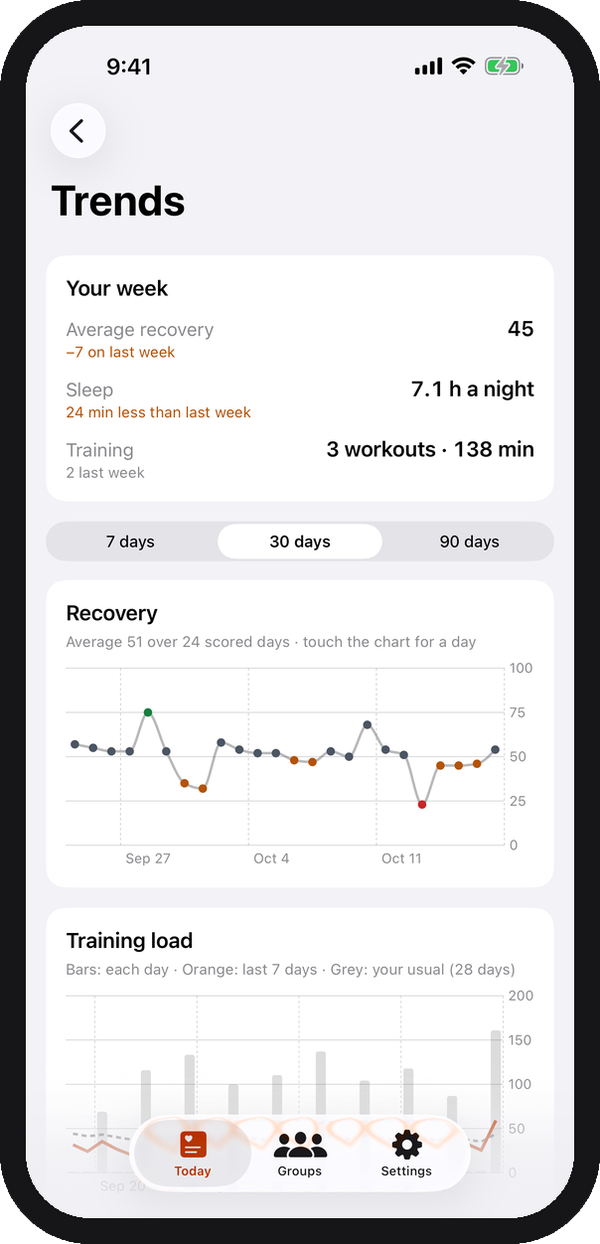
Each session is scored from heart rate and duration where your device records them, and from energy burned or the activity type where it doesn’t. The ramp compares roughly your last week of training with roughly your last month — how fast your training is rising relative to what your body is used to.
It is not an injury prediction. The research linking these ratios to injury is genuinely disputed, so RunPack doesn’t claim it.
RunPack is a training tool, not a medical device. It does not diagnose, treat or prevent any condition, and it can’t tell illness apart from ordinary training fatigue. Talk to a doctor before changing how you train, and if something feels wrong, see one rather than waiting for a number to explain it.
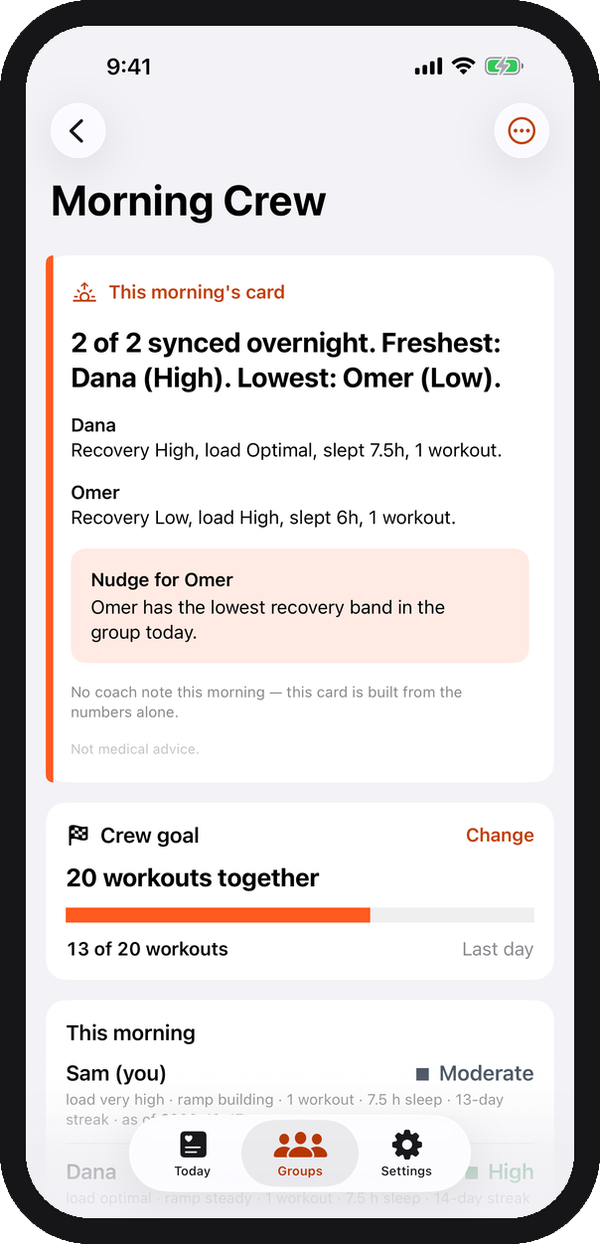
Your crew’s mornings start here.
Start a crew with the people you train with. Works with just your iPhone — free to start, with Apple Watch and widgets too.
Coming soon to theApp Store