RunPack
Free tool
Heart rate zone calculator
Your five heart rate training zones for running. Enter your age; add your resting heart rate for zones based on your heart rate reserve, or your measured maximum if you know it.
Max heart rate 184 bpm (estimated from age). Add your resting heart rate for more personal zones.
| Zone | Heart rate | What it feels like |
|---|---|---|
| Zone 1 · Very easy | 92–110 bpm | Warm-ups, cool-downs, recovery jogs |
| Zone 2 · Easy | 110–129 bpm | Conversational pace; most of your running |
| Zone 3 · Moderate | 129–147 bpm | Steady runs; talking in short sentences |
| Zone 4 · Hard | 147–166 bpm | Tempo and threshold; a few words at a time |
| Zone 5 · Maximum | 166–184 bpm | Short intervals and sprints |
For training guidance only, not medical advice. If you have a heart condition or take medication that affects heart rate, ask your doctor before training by heart rate.
Heart rate zones by age
Estimated with 208 − 0.7 × age and percentages of maximum heart rate. Your own zones may differ; the calculator above can use your resting and measured maximum heart rate.
| Age | Max | Zone 1 | Zone 2 | Zone 3 | Zone 4 | Zone 5 |
|---|---|---|---|---|---|---|
| 20 | 194 | 97–116 | 116–136 | 136–155 | 155–175 | 175–194 |
| 25 | 191 | 96–115 | 115–134 | 134–153 | 153–172 | 172–191 |
| 30 | 187 | 94–112 | 112–131 | 131–150 | 150–168 | 168–187 |
| 35 | 184 | 92–110 | 110–129 | 129–147 | 147–166 | 166–184 |
| 40 | 180 | 90–108 | 108–126 | 126–144 | 144–162 | 162–180 |
| 45 | 177 | 89–106 | 106–124 | 124–142 | 142–159 | 159–177 |
| 50 | 173 | 87–104 | 104–121 | 121–138 | 138–156 | 156–173 |
| 55 | 170 | 85–102 | 102–119 | 119–136 | 136–153 | 153–170 |
| 60 | 166 | 83–100 | 100–116 | 116–133 | 133–149 | 149–166 |
| 65 | 163 | 82–98 | 98–114 | 114–130 | 130–147 | 147–163 |
| 70 | 159 | 80–95 | 95–111 | 111–127 | 127–143 | 143–159 |
How the zones are calculated
Maximum heart rate. The classic estimate is 220 − age. Research by Tanaka and colleagues found 208 − 0.7 × age fits adults better, especially over 40, so the calculator uses that unless you enter a measured maximum.
Percent of maximum. The simplest method: zone 2 is 60–70% of your maximum, zone 4 is 80–90%.
Heart rate reserve (Karvonen). Your reserve is maximum minus resting. Each zone is resting heart rate plus a percentage of the reserve. Two runners with the same maximum but different resting heart rates get different zones, which is why this method feels more personal.
Using zones on a run
- Most runs in zone 2. If you can talk in full sentences, you’re there. See zone 2 running and conversational pace.
- One harder session a week in zones 3–4, like a tempo run, is plenty for most recreational runners.
- Heart rate lags. It takes a minute or two to settle at the start of an effort, and drifts up on hot days and long runs.
- Wrist sensors can wobble during intervals; a chest strap is steadier.
Resting heart rate also tells you about recovery: a morning reading well above your usual can mean you need an easy day. RunPack reads it, along with heart rate variability and sleep, from your watch or ring through Apple Health and turns it into a daily recovery score. See how recovery scores are calculated and what heart rate variability is.
Heart rate questions
How do I calculate my heart rate zones?
Estimate your maximum heart rate (208 − 0.7 × age is a good formula for adults), then take percentages of it: zone 2 is 60–70%, zone 4 is 80–90%. If you know your resting heart rate, the Karvonen method takes percentages of the gap between resting and maximum instead, which gives more personal zones.
What is the Karvonen formula?
Target heart rate = resting heart rate + (maximum − resting) × intensity. For a 40-year-old with a resting heart rate of 60 and a maximum of 180, 70% intensity is 60 + 120 × 0.7 = 144 bpm.
What is zone 2 running?
Easy running at roughly 60–70% of maximum heart rate, where you can hold a conversation. Most training plans put most of your weekly running here, because it builds endurance without much fatigue.
Is 220 minus age accurate?
It’s a rough estimate and can be off by 10 or more beats either way. 208 − 0.7 × age fits adults a little better. A hard race or a guided test gives a truer maximum.
How do I find my resting heart rate?
Measure it lying down just after you wake, before coffee. Watches and rings report it automatically; use the average over a week rather than one morning.
More free tools: running pace calculator · marathon pace chart · VO2 max calculator · running club name generator
Know how hard to go today.
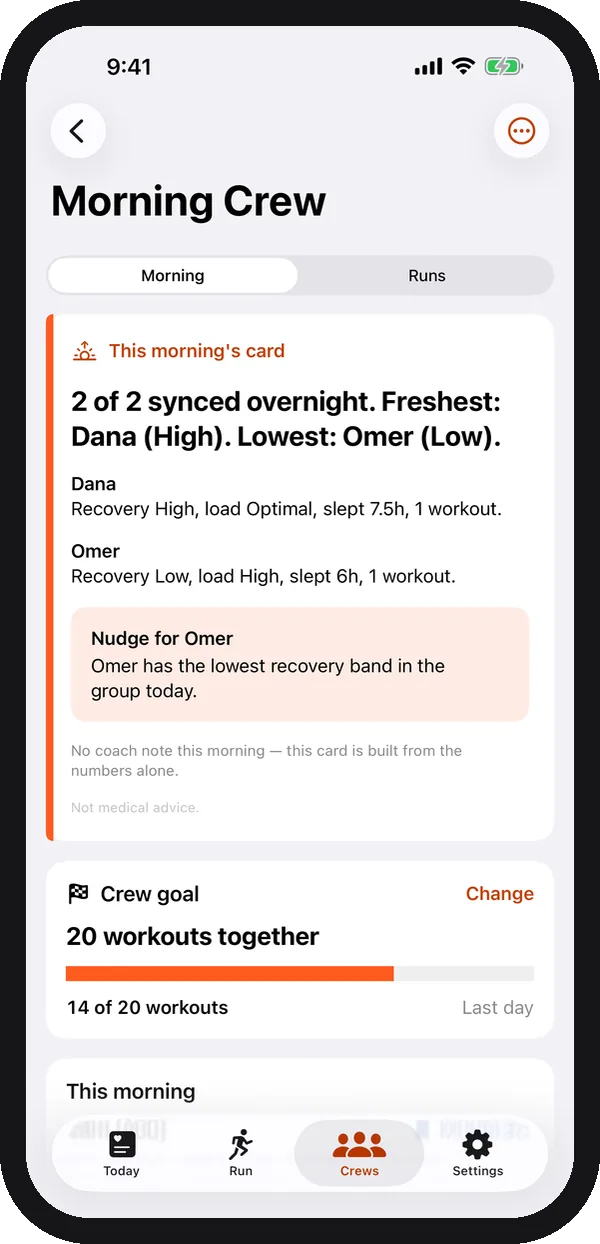
RunPack turns your resting heart rate, HRV and sleep into a daily recovery score, and shares runs with a private crew of friends. Free on iPhone.
Download on theApp Store